Nakasendo Self Guided Itinerary
Enjoy Hiking Japan’s Ancient Road on a Four Day Self-Guided Trip from Tokyo

Enjoy Hiking Japan’s Ancient Road on a Four Day Self-Guided Trip from Tokyo
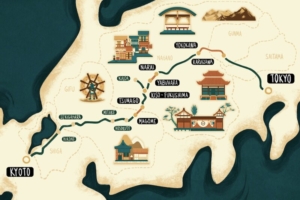
The ancient Nakasendo road
Centuries ago, two major roads connected the ancient capital Kyoto to Edo, the center of power for the Tokugawa shoguns. The Tokaido followed the Pacific coastline, offering an easier but longer journey. In contrast, the Nakasendo provided a faster yet more challenging route through the mountainous interior of the country.
The Tokaido remains well-known and widely used today. Even the bullet train line connecting Tokyo and Kyoto follows its path and bears its name. The Nakasendo, however, faded into obscurity with the advent of railroads. Once-bustling post towns along its route, formerly centers of trade, were forgotten. Their ryokan inns, shops, and houses fell into disrepair.
Fortunately, in the 1960s, locals recognized the historical value of these towns and worked to preserve these important artifacts. The best-preserved post towns can be found in the Kiso River valley, where this journey will take you.
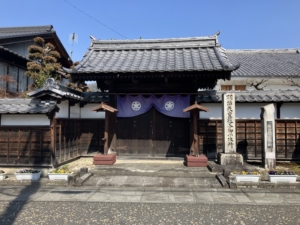
Nakasendo scene at Ochiai-Juku
Today marks the start of your Nakasendo adventure! You will board the bullet train to Nagoya, where you will transfer to another express train bound for the town of Nakatsugawa, the starting point of your hike. The luggage transfer service will collect your bags at the station and deliver them to the guesthouse where you will be staying in Magome-Juku. This gentle, scenic hike takes you through forested paths, quiet hamlets, and rural farmland, following cobbled stretches of the historic Nakasendo. It offers glimpses of Edo-period Japan, with occasional tea houses, moss-covered stone markers, and sweeping mountain views along the way.
Facts about Nakatsugawa and the area: Nakatsugawa is a Japanese halfway between Tokyo and Kyoto. The Kiso River cuts through the area, creating striking rock formations in the Ena Gorge. The Ena Valley is known for its spring cherry blossoms and fall color. The historical Nakasendo route leads to the Edo-era post town of Magome-juku, and a trail climbs up Mt. Ena. North, highlights of the Tsukechi-kyo Valley include waterfalls and the Tsukechi Gorge.
Tip: Leave some time to explore the historic Ochiai-Juku, one of the Nakasendo post towns you will pass through on your way to Magome-Juku
Accommodation: a guest house in Magome-Juku
Distance: 8 km long
Time: between 2 to 2.5 hours at a moderate pace
Difficulty: easy to moderate. The change in elevation is about 350 meters
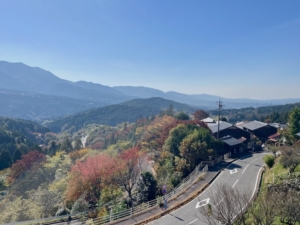
Views of the mountains near Magome-juku
Today, in the early morning take some time to explore Magome-Juku. Walk up the cobbled main street, wander past restored wooden inns, shops, tea houses and the iconic water mill wheel. A side street will take you to Eishō‑ji – a temple with serene grounds and beautiful views to the valley below. Make sure to fuel up with snacks or soba before the hike to Tsumago – there are no places to buy food on the way. Expect to wander through lush cedar woods, quaint villages, scenic rest stops, tea houses, and small waterfalls—all well-signposted and charmingly preserved.
Tip: Aim to reach Tsumago at around 2:30 to 3 pm to be able to have time for sightseeing and to try some of the local delicacies.
Facts about Magome-Juku: Magome stands out as a distinctive post town in Japan due to its location on steep and challenging terrain. It is said that the name Magome (written with “horse” and “basket”) derives from the fact that travelers were forced to leave their horses at the inns because the road was too steep for horses to climb. The cobblestone streets are lined with old, lattice-windowed residential houses, museums, tea houses, and souvenir shops on both sides, a scene that very much resembles how the post town looked in the Edo period hundreds of years ago (visitgifu.com)
Facts about Tsumago-juku: Tsumago is a well-preserved Nakasendo post town, famous for its traditional Edo-era architecture and peaceful atmosphere. Restored in the 1960s to maintain its historic charm, it features narrow streets with wooden buildings and bans modern vehicles to preserve its authenticity. Tsumago offers visitors an immersive experience of Japan’s rural past, complete with traditional inns and local cuisine.
Accommodation: a ryokan in Tsumago or Nagiso OR an onsen hotel in Nagiso
Hiking distance: approximately 8 km
Time: around 2–3 hours at a leisurely pace
Difficulty: easy to moderate, with a steady climb to Magome Pass followed by a gradual descent—mostly forest trail with some paved sections. The trail is well marked
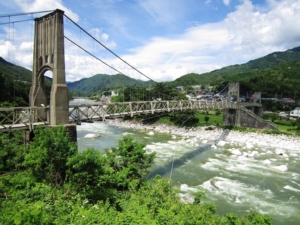
Momosuke Bridge over the Kiso River
Today’s hike begins from Nagiso Station. Before you head to Nojiri, give yourself 30-40 minutes or so to explore the area. Of particular interest is the Momosuke Bridge over the Kiso River. Ione of the longest suspension bridges in Japan, it crosses over the widest part of the river and contributes to the beautiful and majestic scenery.
InNagiso, buy snacks or lunch at station shops, as there may be none along the trail. Follow the riverside trail to Nojiri with a provided map. The path combines modern roadside and original stone paths, winding through forested areas and small hamlets. The Nagiso–Nojiri riverside trail offers a gentle, less touristy riverside walk with glimpses of history.
Ensure you begin the hike early enough to arrive in Nojiri by 2:30 pm to catch the train to Kiso Fukushima, where you will spend the night.
Accommodation: Ryokan or hotel in Kiso-Fukushima
Hiking distance: about 11 km
Time: 4 – 4.5 hrs, depending on speed
Difficulty: mostly flat with elevation of 158 meter
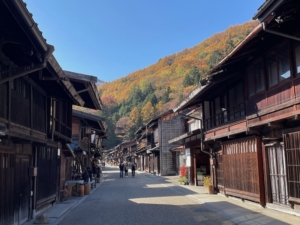
Narai-juku
Today you will take the train from Kiso-Fukushima to Yabuhara where you will begin your hike to Narai-juku over the scenic Torii Pass, the highest point on the Nakasendō. This trail climbs through peaceful forests past shrines and old cobblestone paths. At the summit, a torii gate marks the pass, with views of Mt. Ontake on clear days. Descend into Narai-juku, one of the most atmospheric post towns, known for its well-preserved Edo-period streets, local crafts, and quiet charm. The trail is less crowded, offering a more reflective Nakasendō experience. Bring water and snacks, as there are no shops along the way.
Your luggage will be picked up from your accommodation and delivered to Narai Station. Pick it up before boarding the train to Tokyo.
Facts about Narai-juku: Narai is renowned for its beautifully preserved streets and traditional buildings that offer visitors a authentic glimpse of 17th-18th century Japan. Located in the scenic Japanese Alps, the town boasts stunning mountain views and lush natural surroundings, making it a perfect destination for nature lovers. Additionally, the area is famous for its local crafts, such as woodwork and pottery, which are often sold in charming shops and tea houses along the main street, adding to the town’s charming and historically rich atmosphere.
Hiking distance: ~6 km
Duration: 3–3½ hours at a moderate pace
Difficulty: The trail ascends to approx. 1,197 m at Torii Pass—highest point on this section, then the path descends to Narai